From the crop
Robusta coffee plantation: how we run one in Chikmagalur
7 November 2026 · 5 min read
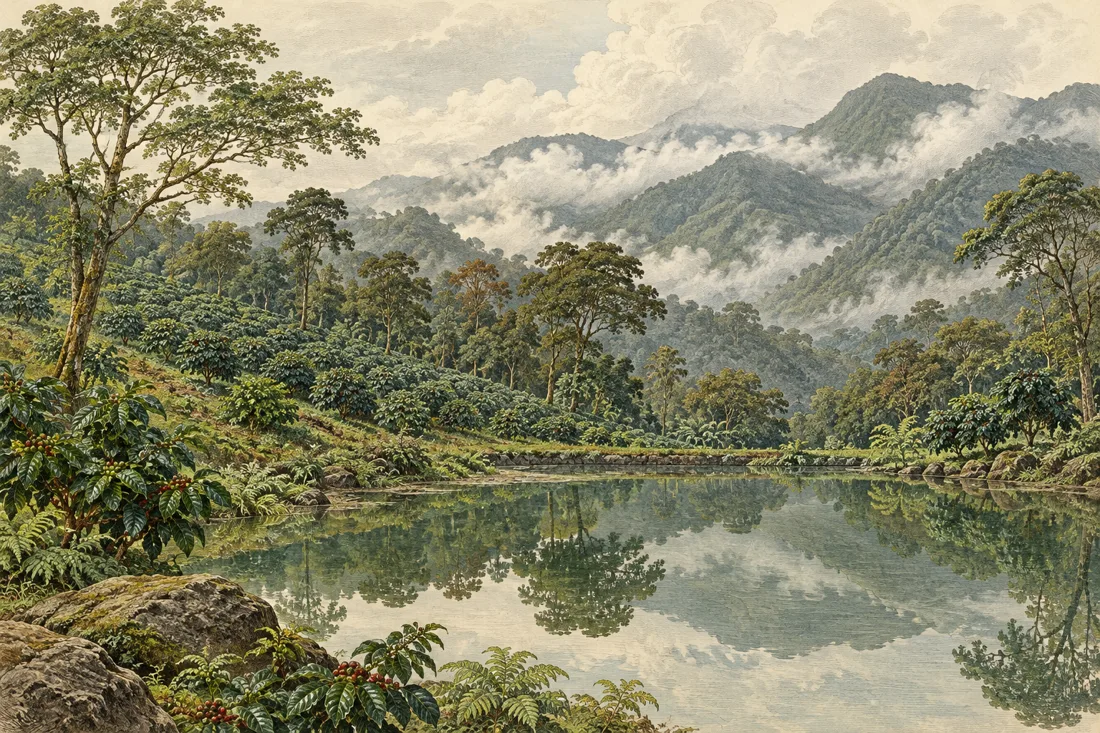
A Robusta coffee plantation runs on water, shade and labour, and the crop is decided by how those three are managed. Most guides stop at a temperature range and a rainfall figure. This is what the decisions have looked like at Nandipura & Indravally Estates, at 3,400 ft in Mudigere, Chikmagalur, including the ones that failed.
What a Robusta plantation is
A Robusta plantation grows Coffea canephora, a coffee native to "the humid, understory evergreen forests" of central and western sub-Saharan Africa, according to World Coffee Research. WCR also notes that a single Robusta tree cannot pollinate its own flowers, as Arabica can.
The same source gives two figures worth setting against the crop's reputation. Robusta can yield well at lower elevations of 200-800 metres. And "temperatures over 20.5 degrees centigrade can have a significantly negative impact on yields", which is why WCR says its ability to thrive in hotter climates may have been overstated. Our estate, at about 1,036 metres, sits above that elevation band.
Robusta is concentrated. WCR reported that six countries account for 95% of output by volume. Robusta is roughly 70% of India's coffee, and a 2024 study puts Karnataka and Kerala at 93% of India's Robusta.
How Robusta came to Nandipura
Robusta was a decision here, not an inheritance. The estate has been farmed by the same family since the 1880s, and until the 1980s it was a complete Arabica zone.
Two Arabica crops in a row came in low. N.M. Jayaram had seen Robusta growing on a trip to Balehonnur, and on his return he planted it. It was one of the first Robusta plantings in the area.
Our Robusta now ranges from two years old to around forty. We wrote about why an all-Arabica estate changed course separately, and Karthik Pattada's film of the blocks, published in September 2026, records the estate's answers.
Water: the low crop that prompted irrigation
Why timing matters
A review of Arabica flowering describes rehydration and cooling at the end of the dry season, the blossom showers, as signals that can restart flower-bud growth.
The Coffee Board's 2016 rainfall insurance booklet for Karnataka gives a useful definition. Robusta blossom showers are the rain between 1 March and 15 April, with a normal requirement of 20 mm over five consecutive days. Backing showers run from the 18th day after blossom showers begin until the 40th, for fruit development and retention, with a normal requirement of 12 mm over two consecutive days; if blossom showers do not arrive, the booklet sets a fallback backing window of 1 to 19 May. These are insurance terms, not irrigation advice.
1991-92
The 1991-92 crop was one of the lowest the estate had picked. We concluded that Robusta at this scale needs irrigation.
Ponds from 1996
From 1996 the investment went into ponds. There are eight on the estate now, and we irrigate by sprinkler.
At one pond, three 20 HP submersible pumps give 60 HP between them. A 150 KVA generator is used for the pulper first and the sprinklers after. It carries seven to eight sprinklers with no head, and six to seven with head. Solar covers only part of the estate, where the subsidy made it worth doing.
The drip trial that failed
We tried spot-jet drip on one block and abandoned it. Gaur and elephants damaged it. The estate is unfenced to wildlife, so anything laid along the ground has to survive them, and this did not.
Shade on a Robusta estate
We carry 30 to 40 shade trees an acre on average. Silver oak is scarce here, which is unusual for an estate. The canopy is the indigenous forest trees left standing from the old plantings, including jackfruit, ficus, fig and Malabar plum. We go into this in what shade-grown coffee means on an Indian estate.
Research finds context-dependent benefits and trade-offs from shade. A 2020 meta-analysis of thirty experimental studies, about half of them from Brazil or India, found that shade improved Robusta growth and yield, and that shade above 30% was associated with reduced beverage quality, with responses varying by tree age and clone. Our figure counts trees and theirs measures cover, so the two cannot be compared directly. We have not published a canopy cover figure.
Yield, and why we do not push it
We expect an average of about 30 bags an acre, and 28 to 30 is a crop we are happy with. We do not aim higher. Expect too much of the plant and the plant weakens.
The pulper is built for 25 tonnes of cherry a day, at six to seven tonnes an hour. It was sized ahead of the current crop on purpose, planned for the coffee increasing. What happens after picking is covered in from cherry to parchment.
Weeding and labour
We use weedicide on the roads only, which is unavoidable at this size. Inside the blocks weeding is manual, at very high cost. One pass around the property takes about a year, and other work falls behind while it happens. The plants are close-set, and the labour is kept at the level that requires.
Anyone planning a Robusta estate should put this cost in the plan from the start.
Replanting and the nursery
Shricharan Jayaram gives Arabica a cycle of about 20 years and Robusta around 45, if the coffee is picked well.
Some growers argue that Robusta should not be replanted. His answer is that a plant carried to a big crop year after year weakens, and that establishment at replanting time is the part that matters. Replanting is also how newer selections reach the estate.
One Robusta block dates from the grandfather's time. Part of it was replanted this season, and more is planned for next year. The film also identifies S.274 among our plantings. WCR records Sln.1R, popularly known as S.274, as the first Robusta selection released by India's Central Coffee Research Institute.
We raise our own coffee and pepper plants in our own nursery rather than buying them in. Selection of seed material is the first decision on a plantation. Arecanut, planted on both sides for shade, came as seedlings from Sagara.
What we have not published
We have not published our acreage, spacing, pruning method or harvest dates here. If you need any of them for a purchase decision, ask us.
If you buy green coffee, send an enquiry about our Robusta parchment. If you would rather see the blocks, visits are by request and free.
Questions
- Does a Robusta plantation need irrigation?
- On our estate, yes. The 1991-92 crop was one of the lowest we have picked, and we concluded that Robusta at this scale needs irrigation. We have built ponds since 1996, and there are eight now.
- How many bags an acre does a Robusta plantation yield?
- It varies by estate. Ours expects an average of about 30 bags an acre and treats 28 to 30 as a good crop. We do not aim higher, because a plant asked for too much weakens.
- How long does a Robusta plant last before replanting?
- Shricharan Jayaram's reckoning is around 45 years if the coffee is picked well, against about 20 years for Arabica. Some growers hold that Robusta should not be replanted at all.
- Is Robusta low-maintenance?
- It still takes substantial work. On our estate, one pass of manual weeding takes about a year.