From the crop
Coffee blossom: rain, wild bees and honey on a Robusta estate
16 November 2026 · 3 min read
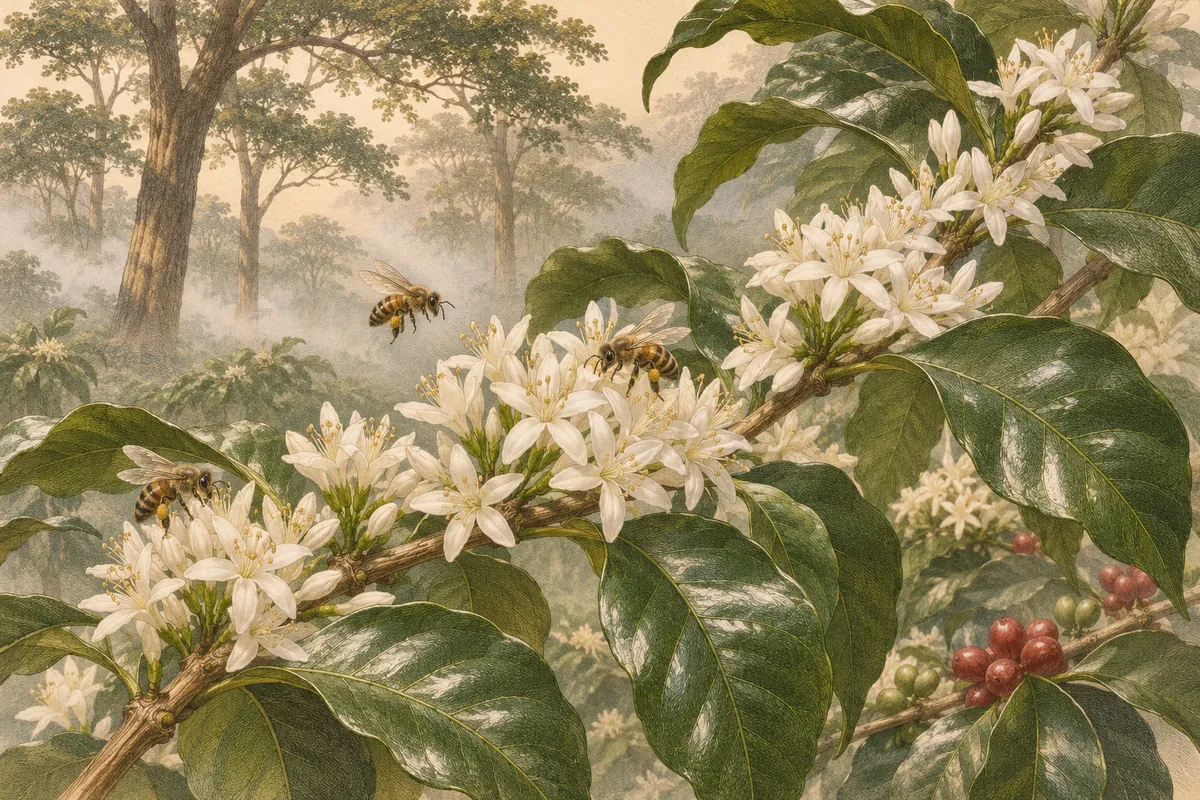
What happens at blossom decides much of the year that follows. At Nandipura & Indravally Estates, at 3,400 ft in Mudigere, Chikmagalur, it depends on three things: rain at the right time, water when the rain does not come, and the wild bees that settle in the shade trees above the coffee.
What sets coffee flowering
Coffee flowers after the dry season, when the first real rain arrives. In Karnataka these are called blossom showers.
The Coffee Board's 2016 rainfall insurance booklet for Karnataka gives the working definition for Robusta: rain between 1 March and 15 April, with a normal requirement of 20 mm over five consecutive days. Backing showers follow for the fruit to set and hold. Those are insurance terms, written to decide when a claim is paid. They are a good description of what a grower is waiting for all the same.
Most of India's Robusta grows in this belt. A 2024 study puts Karnataka and Kerala together at 93% of the country's Robusta, so "coffee blossom season" in India mostly means a few weeks of watching the sky over these two states.
The detail on backing showers, and how they fit the rest of the Robusta year, is in how we run a Robusta coffee plantation.
When the rain does not come
Blossom showers are not reliable, and the estate learned that the expensive way.
The 1991–92 crop was one of the lowest the estate had ever picked. The family's conclusion was that Robusta at this scale could not be grown on rain alone. From 1996 the investment went into ponds. There are eight on the estate now, and the coffee is watered by sprinkler.
The sprinklers run off a generator that is used for the pulper first and the sprinklers after. Drip was tried on one block and given up, because gaur and elephants damaged the lines. The estate is unfenced to wildlife, so whatever waters the blossom has to survive them.
For flowering dates and irrigation details for a particular season, ask us.
Robusta pollination and wild bees
Robusta cannot pollinate itself. World Coffee Research notes that a single Robusta tree cannot pollinate its own flowers, as Arabica can. Pollen has to travel from tree to tree, which is where insects come in.
Nobody keeps bees at Nandipura. Colonies settle in the shade trees on their own, and when the coffee opens they work the blossom below them.
The trees they settle in are the indigenous forest left standing from the old plantings: jackfruit, ficus, fig and Malabar plum, thirty to forty to the acre. Silver oak, the usual shade tree on Chikmagalur estates, is scarce here. Black pepper climbs the same trunks, so one tree carries shade, a pepper vine and a colony at once. There is more on that in what grows under our coffee canopy.
Coffee blossom honey
The honey comes from those same colonies. We take a share late in the season and leave the rest, and it is sold as wild honey.
People search for "coffee blossom honey" as if it were a single-flower honey. Ours is sold as wild honey, from colonies that work the coffee blossom in season.
What the blossom smells like
We will leave this to a visitor. Anne-Laure Hennequin wrote on our Google profile:
The scent of the coffee blossoms is mesmerizing: a bit jasminy and orangy, with some lemontree blossom nuances.
Seeing it
Visits are by request, and free. The flowering moves with the rain, so if you want to see the blossom, write to us before you plan the trip and we will tell you how the season is going.
Questions
- When does Robusta coffee blossom in Karnataka?
- The Coffee Board's 2016 rainfall insurance booklet for Karnataka treats rain between 1 March and 15 April as the Robusta blossom-shower period. Flowering on any one estate follows the rain or irrigation it actually gets, so ask the estate about a particular season.
- What are blossom showers?
- The first rains at the end of the dry season that set coffee flowering. The Coffee Board's insurance booklet puts the normal requirement for Robusta at 20 mm over five consecutive days, followed by backing showers that help the fruit set and hold.
- Are the bees at Nandipura kept?
- No. Colonies settle in the shade trees on their own and work the coffee blossom. The estate takes a share of their honey late in the season and leaves the rest.
- Why does Robusta need cross-pollination?
- World Coffee Research notes that a single Robusta tree cannot pollinate its own flowers, as Arabica can, so pollen has to move between trees.