Estate diary
Mudigere in the monsoon
25 October 2026 · 2 min read
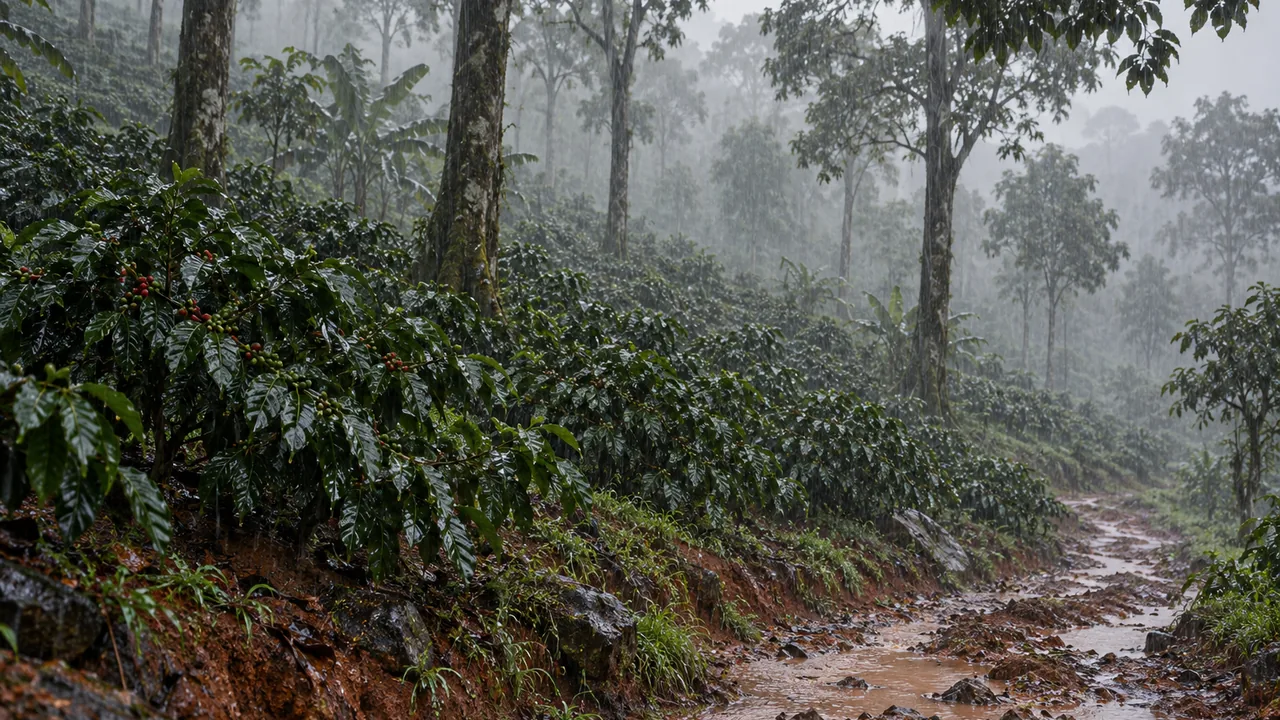
Mudigere receives mean annual rainfall of about 2,173 mm, according to the Central Ground Water Board’s 1996–2005 table reproduced in SICC’s account of the Chikmagalur growing region. SICC places Mudigere in wet Malnad, describing it as more consistently humid and forested than the drier eastern Chikmagalur taluks.
This is Chikmagalur in monsoon as the records and our own notes describe it: how much rain falls, where the Hemavati starts, and what a planter said about water while it rained.
When the rain falls
The timeanddate climate averages for Mudigere show the broad seasonal pattern: most rain falls in June–August, with July the wettest month. Rain decreases in September, and conditions become much drier from October onward.
Wikipedia’s Mudigere entry gives the town an average elevation of 990 m, or 3,250 ft, and notes its coffee and black pepper cultivation. Nandipura & Indravally Estates stands at 3,400 ft above mean sea level.
The Hemavati at Javali
Wikipedia notes that the Hemavati River rises at Javali, in Mudigere taluk in the Western Ghats, at about 1,230 m. It then flows through Hassan district.
Javali village is about 40 km by road from the estate, measured on OpenStreetMap.
The Charmadi road
The Sunset Valley’s guide to tourist attractions in Chikmagalur names June–September as the best time to visit Charmadi Ghat.
Charmadi village, at the foot of the ghat, is about 54 km by road from the estate.
What the estate film records
Karthik Pattada’s film, published on 1 September 2026, records a visit in rain, before the crop. He travelled through the blocks by jeep, with Shricharan Jayaram answering questions about the coffee, shade and irrigation.
The notes describe indigenous forest trees retained as canopy, with silver oak scarce. The Robusta plantings discussed ranged from two years old to 35–40 years old. Our account of walking the Robusta blocks follows that filmed visit.
Why the ponds were built
The estate’s water history begins with a difficult crop. In 1991–92, Nandipura picked one of its lowest crops and concluded that Robusta at this scale needed irrigation.
Investment in ponds began in 1996. There are eight in all. At the pond shown in the film, three 20 HP submersible pumps serve the irrigation system. A trial of spot-jet drip on one block had been abandoned after damage from gaur and elephants.
Visits are by request and at no charge, by arrangement rather than on a schedule. The homestay is planned and not yet bookable.